
Teaching your child the Quran online can be an incredibly rewarding experience, but many parents unintentionally make mistakes that may slow their child’s progress or affect their confidence in learning. With the increasing popularity of online Quran academies, it has become more important than ever to understand the best ways to guide children effectively, ensuring that learning remains enjoyable, structured, and spiritually meaningful.
At Al Ziyai Academy, we offer carefully structured online programs including Noorani Qaida, Quran Reading & Tajweed, Quran Memorization, Arabic Language, and Islamic Studies for Kids. These programs are specifically designed to support both parents and children, providing step-by-step guidance, expert teaching, and personalized attention. By following a proven structure, children gain confidence, improve their recitation, and develop a deep connection with the Quran and Allah’s teachings.
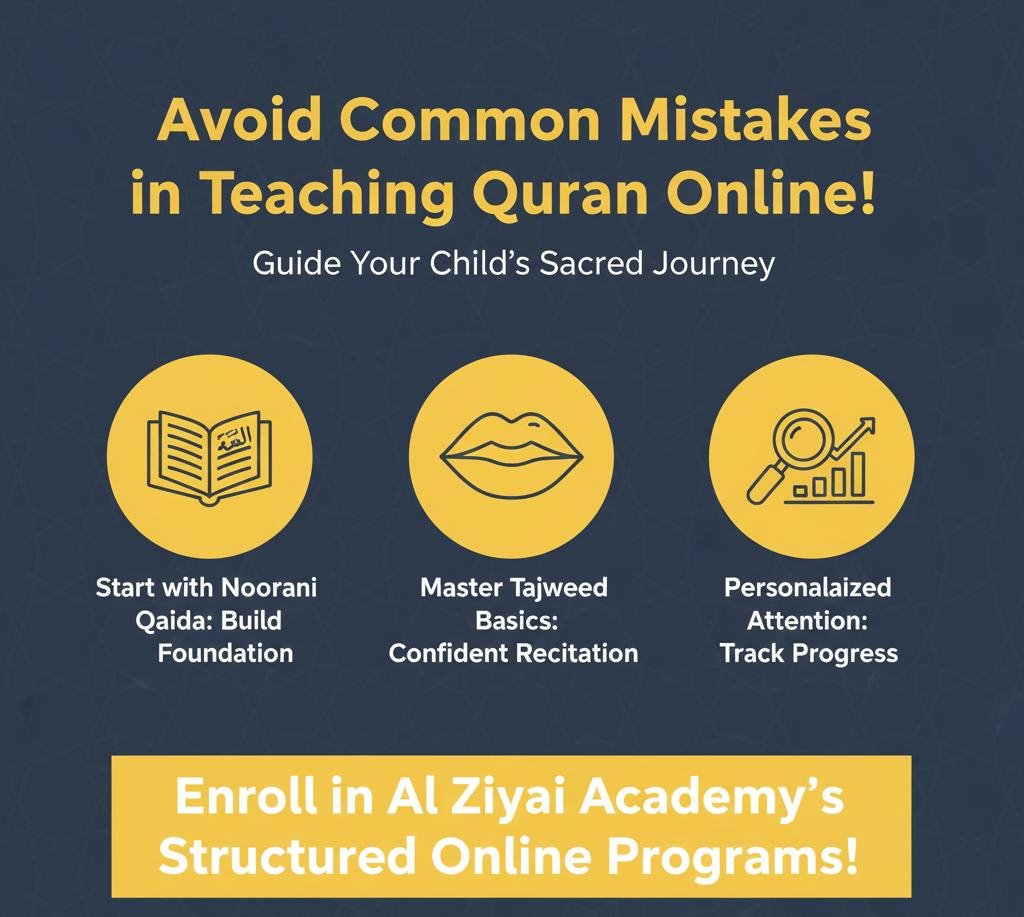
This blog highlights the top 7 mistakes parents often make while teaching the Quran online and provides practical solutions to avoid them. By understanding these common pitfalls, parents can ensure their children learn more effectively, enjoy the process, and cultivate a lifelong love and respect for the Quran. Implementing these strategies helps children build strong foundations in reading, Tajweed, memorization, and comprehension, while also nurturing moral values and spiritual growth from an early age.
1. Not Starting with Noorani Qaida
One of the most common mistakes parents make is skipping Noorani Qaida. Many want their children to start reading the full Quran immediately, hoping for quick progress. However, without a strong foundation, children often struggle with pronunciation, fluency, and applying Tajweed rules correctly. Noorani Qaida provides the essential building blocks — teaching Arabic letters, sounds, and basic recitation patterns — which prepare children for accurate and confident Quran reading. Skipping this step can lead to frustration, mistakes, and slower progress, making it harder for children to develop a lasting connection with the Quran.
Why Noorani Qaida Is Essential
- Teaches Arabic letters and their correct pronunciation (Makharij)
- IntrNoorani Qaida is essential because it:
- Teaches Arabic letters and their correct pronunciation (Makharij) — helping children articulate each letter properly
- Introduces basic vowels, symbols, and rules — providing the foundation for accurate reading
- Provides step-by-step progression from letters to words — ensuring children learn gradually without confusion
- Prepares children for advanced recitation — making Quran Reading & Tajweed easier and more enjoyable
- Skipping this foundational step can make the learning process frustrating, slow, and less effective. Beginning with Noorani Qaida allows children to develop confidence, enjoy their lessons, and build a strong foundation that supports all future Quranic studies.
- For more guidance on the benefits of early learning, check Top 5 Benefits of Starting Quran Learning at an Early Age.oduces basic vowels, symbols, and rules
- Provides step-by-step progression from letters to words
- Prepares children for advanced recitation
Skipping this step can make the learning process frustrating and slow. Starting with Noorani Qaida ensures that children develop confidence and enjoy reading Quran from the beginning.
For more on the importance of starting early, check Top 5 Benefits of Starting Quran Learning at an Early Age.
2. Skipping Tajweed Basics
Tajweed is essential for reading the Quran accurately and beautifully. When children skip the foundational basics, such as proper pronunciation of letters and understanding of vowel rules, they often develop incorrect reading habits. This can lead to poor pronunciation, frequent mistakes, and confusion as they progress to longer verses and advanced recitation. By learning Tajweed from the beginning, children gain confidence, clarity, and the ability to recite the Quran correctly, setting them up for a successful and enjoyable learning journey.
How to Avoid This Mistake
To ensure proper Quranic recitation, it’s important to:
- Include Tajweed lessons from the start — teaching children correct pronunciation and basic rules early
- Use Quran Reading & Tajweed programs to reinforce rules — applying what they learn in a structured way
- Practice proper articulation points and correct letter sounds — ensuring each letter is pronounced accurately
Learning Tajweed not only improves recitation quality but also boosts confidence when children read aloud. By mastering these rules early, children develop clarity, accuracy, and a love for the Quran. For a detailed guide on Tajweed and its benefits, see Why Learning Tajweed Is Essential for Every Quran Student.
3. Ignoring Personalized Attention
Every child has a unique learning pace. While some children quickly recognize Arabic letters and grasp pronunciation, others may require extra time and repeated practice to fully understand each concept. Ignoring these individual differences can lead to mistakes, low confidence, and frustration, making Quran learning stressful for both the child and the parent. By acknowledging each child’s pace and providing personalized guidance, parents and teachers can ensure steady progress, build confidence, and make the Quran learning journey enjoyable and effective.
How Online Learning Provides Personalized Attention
1-on-1 classes provide children with focused and personalized learning, allowing teachers to concentrate entirely on each student’s needs. In this environment, teachers can identify weak areas, adjust lessons, and provide extra practice where necessary. This personalized guidance helps children feel supported, motivated, and confident in their learning journey. Whether it is Noorani Qaida, Quran Reading & Tajweed, or Arabic Language, one-on-one attention ensures that children learn correctly, efficiently, and at their own pace, laying a strong foundation for all future Quranic and Islamic studies.
4. Not Monitoring Your Child’s Progress
Many parents assume that simply enrolling their child in online Quran classes is enough for effective learning. However, without active monitoring, children may develop bad habits, repeat mistakes, or miss important corrections from their teacher. Regular parental involvement — observing lessons, checking progress, and encouraging practice — ensures that children stay on track, build proper recitation skills, and develop a strong connection with the Quran from the very beginning.
How to Stay Involved
To ensure effective online Quran learning, parents can take a proactive role by:
- Sitting with your child occasionally during online sessions — observing how lessons are delivered and how your child responds
- Asking teachers for regular updates on progress — understanding areas of strength and where extra support is needed
- Reviewing your child’s recitation and Tajweed at home — reinforcing correct pronunciation and rules
Programs like Islamic Studies for Kids also provide opportunities for parents to track learning progress while children learn important values such as honesty, patience, and respect. This active involvement ensures that children stay motivated, correct mistakes early, and build both strong Quranic skills and good character.
5. Overloading Children with Memorization Too Soon
Attempting to have children memorize large portions of the Quran before they have a solid understanding of letters, words, and basic pronunciation can easily overwhelm them. Without a strong foundation, children may feel confused, frustrated, or stressed, which can reduce their interest, motivation, and confidence in learning. By first focusing on Noorani Qaida and proper recitation skills, children develop the necessary reading and comprehension abilities, making memorization easier, more meaningful, and enjoyable. This step-by-step approach ensures they build both accuracy and a lasting love for the Quran.
How to Introduce Memorization Gradually
To make Quran memorization effective and enjoyable for children, it is important to:
- Start with short surahs and simple words — building confidence and ensuring accurate recitation
- Combine memorization with recitation practice — reinforcing correct pronunciation and fluency
- Encourage children to understand meanings during Hifz lessons — connecting memorized verses with their spiritual significance
This approach not only makes memorization easier but also strengthens comprehension and emotional connection with the Quran. Your blog The Importance of Hifz-ul-Quran explains how combining memorization with understanding helps children retain verses more effectively while deepening their spiritual connection and love for Allah’s words.
6. Choosing the Wrong Online Academy
Not all online Quran programs provide the same quality of education. Some may lack a structured curriculum, while others may not have qualified and experienced teachers, both of which can negatively affect a child’s learning journey. Without proper guidance, children may develop incorrect recitation habits, slow progress, or reduced confidence. Choosing a program with a well-organized curriculum, experienced instructors, and personalized attention ensures that children learn the Quran correctly, build a strong foundation, and enjoy a rewarding and spiritually fulfilling experience.
How to Choose the Right Online Academy
When choosing an online Quran program, parents should:
- Ensure teachers are qualified and experienced — capable of guiding children with correct pronunciation, Tajweed, and recitation techniques
- Look for programs that include Noorani Qaida, Quran Reading & Tajweed, Arabic Language, and Islamic Studies for Kids — providing a complete and structured learning journey
- Check reviews and feedback from other parents — confirming the program’s effectiveness and reliability
At Al Ziyai Academy, children receive professional guidance in a safe and supportive environment. Expert teachers ensure steady progress, correct recitation, and a love for learning the Quran, while parents can feel confident that their child is receiving the best possible Quranic education.
7. Not Combining Recitation with Understanding
Some parents focus solely on recitation, expecting children to memorize verses without understanding their meanings. While accurate recitation is important, neglecting comprehension can make learning mechanical, repetitive, and less spiritually fulfilling. Children may recite the Quran correctly but fail to connect with its teachings, values, and guidance. By combining recitation with understanding, children not only read accurately but also reflect on the meanings, internalize moral lessons, and develop a deeper love and connection with Allah’s words.
How to Avoid This Mistake
To ensure children connect with the Quran on a deeper level, parents can:
- Introduce basic Arabic words through the Arabic Language course — helping children recognize common vocabulary in verses
- Discuss simple meanings of surahs and verses — making recitation meaningful and relevant
- Encourage reflection on Allah’s guidance during recitation — fostering a spiritual and moral connection
This approach transforms Quran learning from mere memorization to an engaging and insightful experience. For a deeper understanding, see Benefits of Learning Quran Online for Kids and Adults and How Learning Arabic Helps You Understand the Quran Better, which explain how comprehension enhances both recitation and spiritual growth.
FAQs – Common Questions Parents Have
Q1: At what age should children start online Quran classes?
Children can begin as early as 4–5 years old with Noorani Qaida, building a strong foundation in Arabic letters, pronunciation, and basic Quranic reading skills.
Q2: Can online Quran learning replace traditional classes?
Yes! With 1-on-1 guidance, structured courses, and qualified teachers, online Quran classes are highly effective and often provide more personalized attention than traditional settings.
Q3: How long does it take for a child to complete Noorani Qaida?
The duration typically ranges from 3 to 6 months, depending on the child’s learning pace, consistency, and practice. Regular guidance ensures smooth and confident progress.
Q4: Should parents monitor online classes?
Absolutely! Active monitoring helps ensure proper recitation, correct pronunciation, and consistent progress. Parents can observe lessons, review recitation, and coordinate with teachers for feedback.
Q5: How can I enroll my child?
Enrollment is simple. Parents can visit the Contact Us page to register their child or get detailed information about schedules, fees, and programs. The academy team will guide you to select the most suitable course for your child’s Quran learning journey.
CONCLUSION
Teaching a child the Quran online can be simple, effective, and spiritually enriching when parents are aware of common mistakes and follow a structured approach. Beginning with Noorani Qaida, reinforcing proper Tajweed, providing personalized attention, gradually introducing Quran Memorization, integrating Arabic learning, and maintaining daily consistency helps children become confident, disciplined, and morally strong.
At Al Ziyai Academy, our carefully designed programs — including Noorani Qaida, Quran Reading & Tajweed, Quran Memorization, Arabic Language, and Islamic Studies for Kids — ensure that every child enjoys learning the Quran while building a strong foundation in both knowledge and Islamic values.
Start your child’s online Quran journey today to provide them with the right foundation, foster a lifelong love for the Quran, and guide them toward becoming spiritually connected, confident, and well-rounded individuals.